
Quick answer: A professional tree removal follows six steps: assessment and quote, permit and utility checks, site preparation, taking the tree down in sections, cleanup, and stump grinding. Many single-tree removals are finished within a day. Large trees, and trees over buildings or power lines, take longer.
Knowing the order of work makes it easier to compare quotes and get your yard ready. This guide follows a typical residential job in Denver from the first visit to the last rake-up. For the service itself, see tree removal in Denver.
What are the steps in a tree removal?
- Assessment and quote. The tree’s height, lean, condition and surroundings are checked, and you get a written price. See tree removal cost in Denver for what goes into it.
- Permit and utility checks. A tree in the public right-of-way needs a free City Forester permit before work starts. See tree removal permits in Denver.
- Site preparation. Vehicles and furniture are moved, the drop zone is cleared and a route is set for brush and logs.
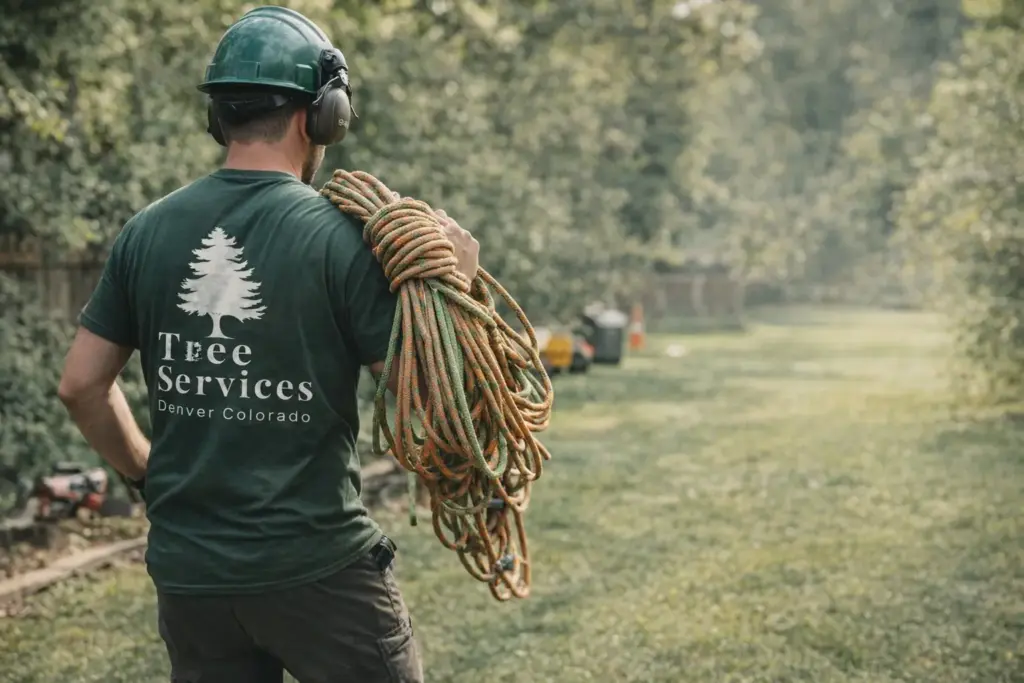
- Taking the tree down. In open ground a tree can be felled in one piece. In most yards a climber removes the limbs first, then the trunk in sections, lowering pieces on ropes where they cannot fall freely.
- Cleanup. Brush is chipped, logs are cut and hauled away, and the area is raked.
- Stump grinding. If it is in the quote, the stump is ground below ground level and the hole is filled.
How long does tree removal take?
| Job | Typical time on site |
|---|---|
| Small tree in an open yard | 1 to 3 hours |
| Medium tree with good access | Half a day |
| Large tree, or any tree over a building or wires | A full day or more |
| Stump grinding, per stump | About 1 to 2 hours |
These are typical figures, not promises. Access, the amount of rigging and the weather all move them. Ask for a time estimate with your quote.
How should you get your yard ready?
- Move cars out of the driveway and away from the street in front of the tree
- Clear patio furniture, planters and toys from under the canopy
- Unlock gates and point out the widest route to the tree
- Mark sprinkler heads, shallow irrigation lines and anything fragile
- Keep children and pets indoors while the crew is working
- Let neighbors know if limbs overhang their side
What happens to the wood?
By default, brush is chipped and the logs are hauled away. If you want to keep the chips as mulch or the logs as firewood, say so before the job starts. It can reduce the haul-away part of the price.
What is left when the crew leaves?
If the stump was not part of the job, you will have a low stump and some sawdust. Stump grinding removes it and leaves the spot ready for lawn or planting. Before any grinding, underground utilities have to be located through Colorado 811, which asks for at least three business days of notice.
When does the process change?
A tree that has already fallen, or is about to, skips the scheduling steps. See emergency tree removal. Timing matters for planned work too: our guide to the best time of year to remove a tree in Denver explains why winter jobs often go more smoothly. If you are still deciding whether the tree has to go, start with the signs a tree needs to be removed.
Tree removal process FAQs
How long does it take to remove a tree?
Many single-tree removals are finished within a day. A small tree in an open yard can take a couple of hours. A large tree over a building can take a full day or more, because it has to come down in small sections.
Do I need to be home during tree removal?
Not necessarily, as long as the crew can reach the tree and you can be contacted by phone. It helps to be there at the start to confirm which tree is coming down and where the stump and wood are going.
Will tree removal damage my lawn?
Some marks are possible where sections land and where equipment crosses the grass. Firm, dry or frozen ground helps, and so does a clear route to the tree. Tell the crew about sprinkler heads and anything fragile beforehand.
Can the stump be ground the same day?
Often, yes, if grinding was included in the quote and underground utilities have already been located. In Colorado the locate is requested through Colorado 811, which asks for at least three business days of notice.