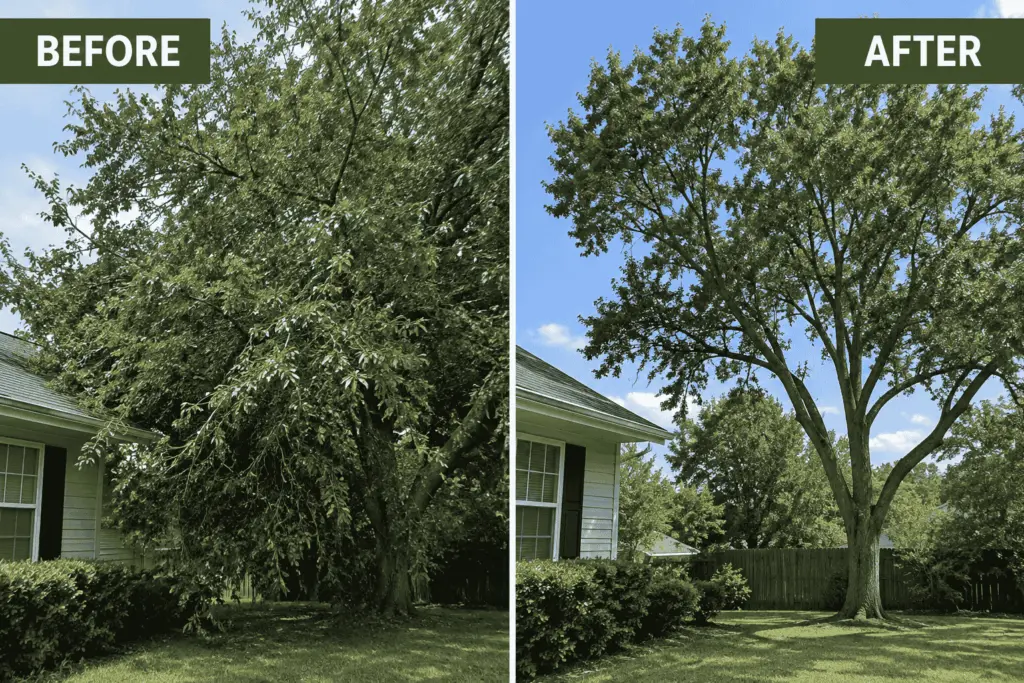

Quick answer: Tree topping is cutting a tree’s main branches back to stubs to reduce its height. It is harmful: it strips away the leaves the tree feeds on, opens large wounds to decay and triggers fast, weakly attached regrowth. Crown reduction, which shortens branches back to a healthy side branch, lowers a tree without that damage.
Topping is still offered because it is quick and looks like a bargain. This guide explains what it does to a tree and what to ask for instead. For proper pruning, see tree pruning and trimming in Denver.
Why is topping bad for trees?
- It starves the tree. Leaves make a tree’s food. Removing most of the crown at once removes most of its food supply.
- It opens the tree to decay. Stub cuts are large and made in the wrong place, so they close slowly or not at all.
- It creates weak regrowth. The tree responds with clusters of fast upright shoots that are poorly attached and break easily.
- It makes the tree more dangerous. Within a few years the tree is as tall as before, with weaker branches.
- It costs more over time. The regrowth has to be cut again and again.
The Colorado State Forest Service includes it in its basic pruning advice: keep one dominant leader and do not cut off the tops of trees.
What does Denver say about topping?
For trees in the public right-of-way, usually the strip between the sidewalk and the street, the rule has teeth. The Office of the City Forester states that if a right-of-way tree is improperly pruned, and topping is the example it gives, the City Forester may deem the tree irreparably damaged and require reimbursement for its value. The adjoining property owner is responsible for those trees.
What should you ask for instead of topping?
| What you want | Ask for |
|---|---|
| A shorter or narrower tree | Crown reduction back to side branches |
| More light in the yard | Crown thinning |
| Branches off the roof or over the driveway | Crown raising or clearance pruning |
| Less risk in snowstorms | Deadwood removal and structural pruning |
| A tree that is simply too big for the spot | Removal and a smaller replacement |
The pruning types are explained in tree pruning vs. tree trimming. If the tree has outgrown its space for good, see tree removal in Denver.
Can a topped tree be saved?
Often, with patience. Restoration pruning over several visits selects the strongest of the new shoots, removes the rest and gradually rebuilds a sound crown. It does not work on every tree. If the stubs have decayed or the tree is in decline, removal may be the safer course. The signs a tree needs to be removed will help you judge.
How do you avoid it?
Ask what type of pruning is being quoted and where the cuts will be made. Proper cuts are made just outside the branch collar, back to a side branch or the trunk, not partway along a limb. The right season is covered in the best time to prune trees in Denver. Prune on a regular cycle so the tree never needs drastic work: see how often to trim trees in Denver.
Tree topping FAQs
Is it illegal to top a tree in Denver?
No permit is needed to prune a tree on private property in Denver. For trees in the public right-of-way, the City Forester can treat topping as irreparable damage and require the owner to pay the value of the tree.
Will a topped tree grow back?
Yes, and quickly, but not well. The new shoots are crowded and weakly attached, so the tree soon regains its height with branches that are more likely to break.
What is the difference between topping and crown reduction?
Topping cuts branches to stubs at an arbitrary height. Crown reduction shortens each branch back to a healthy side branch that is large enough to take over, which keeps the tree’s natural shape and lets the wounds close.