
Quick answer: A storm-damaged tree can usually be saved if its main trunk is intact, most of its major limbs are still attached and at least half of its crown is left. A split trunk, a broken main leader on a tree that cannot regrow one, or the loss of most of the canopy usually means the tree should be removed.
Trees look worse than they are right after a storm, and plenty are removed that would have recovered. In Denver the cleanup falls to the owner: see who is responsible for fallen branches. This guide helps you sort the two. For the work itself, see storm damage tree cleanup in Denver.
How do you judge the damage?
| What you see | Outlook |
|---|---|
| Small branches broken, structure intact | Good. Clean up and prune |
| A few large limbs broken, more than half the crown left | Good with corrective pruning |
| Main leader broken | Uncertain. Depends on species and age |
| Less than half the crown left | Poor. The tree may not feed itself |
| Trunk split or large bark torn away | Poor. Usually removal |
| Roots lifted, tree leaning | Hazard. Urgent removal |
What questions decide it?
- Was the tree healthy before? A vigorous tree recovers from damage that would finish a declining one.
- How big are the wounds? Small wounds close. Wounds wider than the remaining branch struggle to.
- What is left to grow from? Enough sound branches to rebuild a balanced crown.
- What is underneath it? A weakened tree over a house needs a stricter standard than one in open ground.
What helps a damaged tree recover?
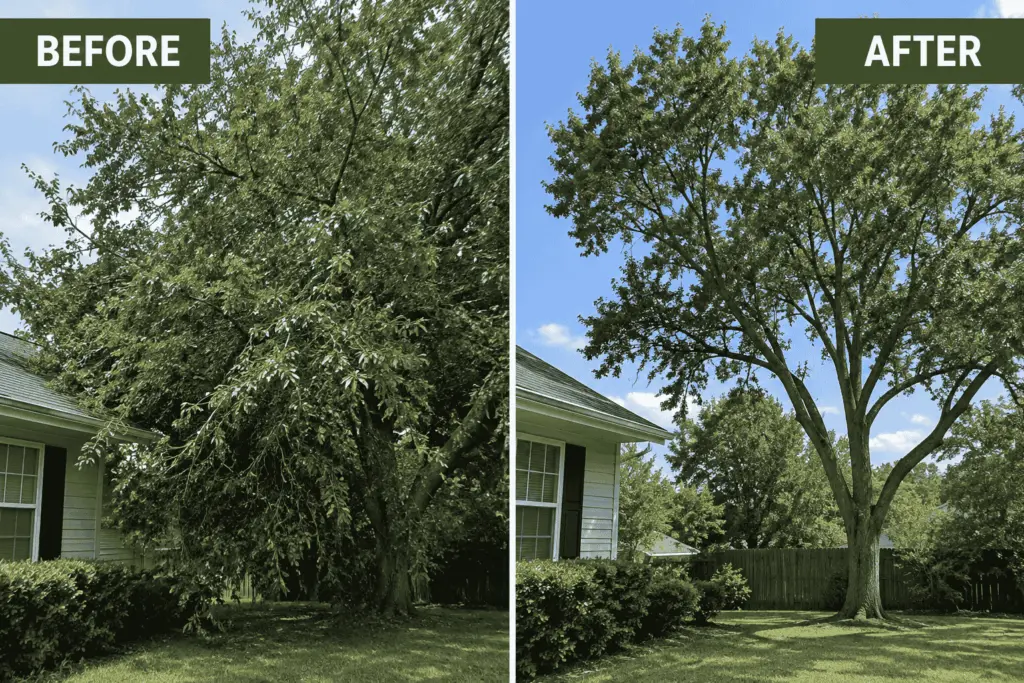
- Remove hanging and broken limbs. These are the immediate danger.
- Make clean cuts. Torn stubs are pruned back to the branch collar or a sound side branch.
- Keep what you can. The tree needs its remaining leaves to recover.
- Wait before major decisions. Give a borderline tree a growing season before deciding.
The pruning is the same work described in tree pruning in Denver. To prepare the tree for the next storm, see how to protect trees from heavy snow in Denver. Heavier corrective pruning can follow in late winter: see the best time to prune trees in Denver.
What should you avoid?
- Topping. Cutting everything back to stubs does more harm than the storm did. See why tree topping harms trees.
- Wound paint. Sealing cuts is no longer recommended. Trees close wounds on their own.
- Over-pruning. Do not take off healthy branches to balance the look.
- Door-to-door offers. After a storm, take time to get a written quote.
When is removal the right call?
When the trunk is split, the roots have lifted, or too little crown is left to keep the tree alive. Those match the signs a tree needs to be removed. If the tree is leaning on a structure or could fall on one, treat it as an emergency: see emergency tree removal. Otherwise, see tree removal in Denver. If it does come down, some species cope with Denver snow better than others: see which trees break most in Denver snowstorms?
Storm-damaged tree FAQs
Can a tree survive losing half its branches?
Often, if it was healthy beforehand and the trunk and main limbs are sound. Below about half of the crown, the tree may not produce enough food to recover.
Can a tree with a split trunk be saved?
Rarely. A split trunk is a structural failure, and the tree is likely to break further. In most cases removal is the safe choice.
How long does a storm-damaged tree take to recover?
Several years. The tree regrows its crown gradually, and follow-up pruning over that time helps it rebuild a sound structure.